
Social Media Use and Emotional Well-Being: Can we use responsibly or are we victims of the algorithm?
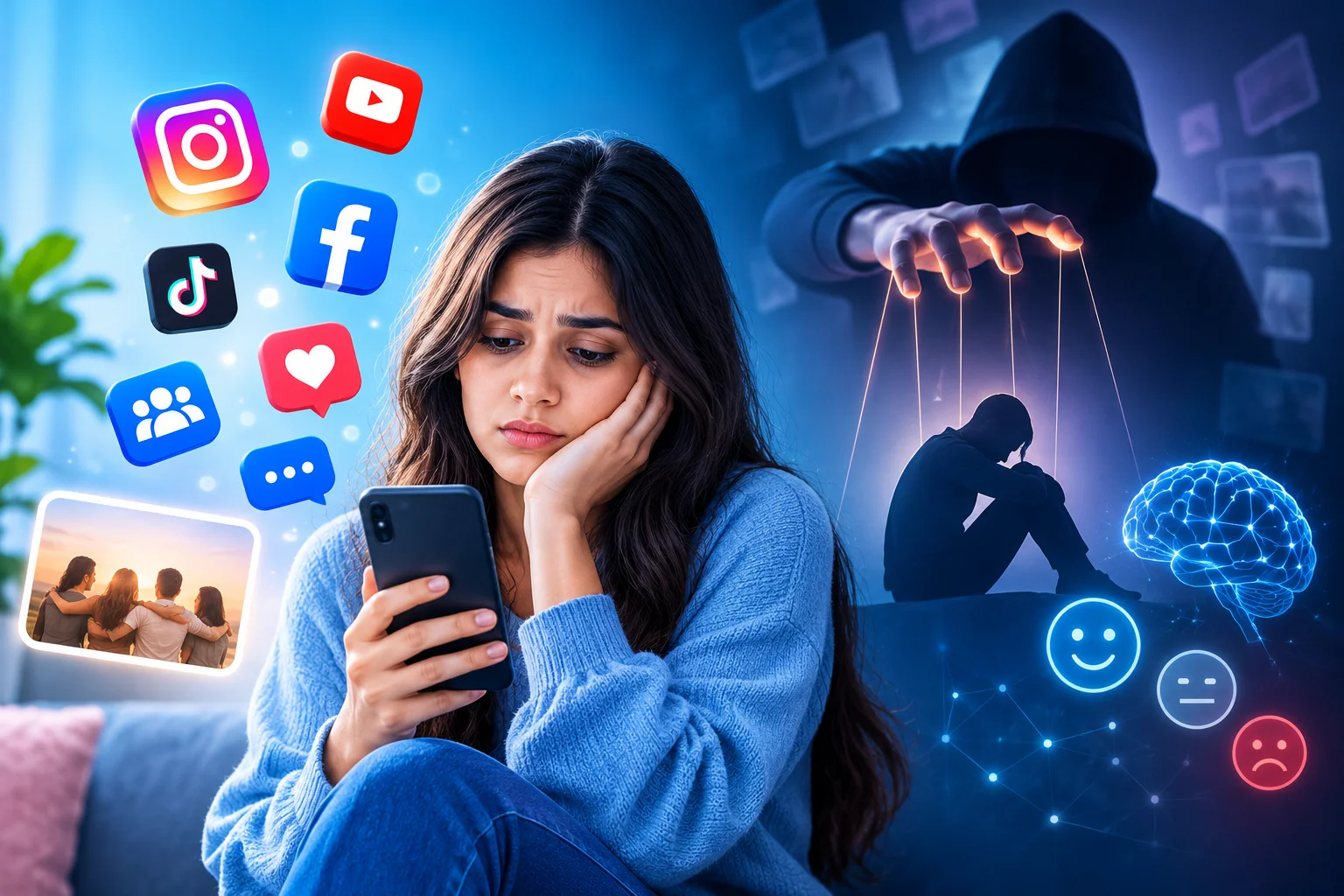
Our lives are increasingly moving toward using social media. We also have group chats, make jokes, tell stories, watch videos, learn new things and catch up on the news through the internet sites like YouTube, Facebook, Snapchat, Twitter and Instagram. Our use of the internet has the potential to affect our lives, mood and self-esteem. According to the Internet and Mobile Association of India (IAMAI) and Kantar’s Internet in India 2024 report, India had approximately 886 million active internet users in 2024, highlighting the enormous population potentially exposed to algorithm-driven digital environments.
But a bigger question emerges. Is there such a thing as responsible social media usage, or are we simply falling prey to the algorithm? Unfortunately, we need to go about that understanding in whatever way the platforms work and we use them.
At Harmony Mind Clinic, we understand that social media can influence our emotions, self-esteem, sleep, and overall mental well-being. Learning to use social media responsibly can help individuals develop healthier digital habits and maintain a better balance between online activities and everyday life.
What Impact Does Social Media Have on Emotions?
Can social media be bad for mental health? It helps people to stay connected, find support and share. Online communities can also help us feel less isolated. Social media engagement involves brain systems associated with reward processing, attention, learning and social evaluation. Features such as unpredictable rewards, notifications and personalised recommendations may reinforce habitual checking, although their effects vary substantially between individuals.
Be warned that heavy scrolling can sometimes even lead to stress and emotional pressure. By looking at carefully edited photos and success stories, one might compare life with that of another.
Typical emotional responses are:
It’s impossible to sit still sometimes with an onslaught of notifications and online expectations.
Unconfident: Parochising your own self against the rest of the world will affect your self-esteem, including your attitude, way of life, or achievement.
Sleep problems: Delay sleep or interrupt sleep by using social media in the evening.
If you’re connected online for long periods of time, this also can lead to feeling emotionally exhausted.
It varies for everyone. How long the individual is on the internet, what they were actually looking at and various other personal factors.
Are We Victims of Social Media Algorithms?
This is the algorithm that determines what you see in your feed. The algorithm takes your activity (like comment, search, comment, like, watch time, and so on) to recommend similar content.
Their goal is to teach us new things. That’s why one video can go on for a second, and scrolling through can get a little out of hand.
How to Use Social Media Responsibly
Being good to yourself while using social media doesn’t mean that we need to avoid social media all together. Instead, it involves setting boundaries and being aware of your mood as you use social media.
Here are some steps you can take:
Put a time limit: Decide how much time you’d like to be on social media each day.
Follow pages that make you wiser, stronger or happier.
Remember that what someone puts online is only a tiny snippet of his or her entire life.
Turn off or hide non-important notifications to help reduce distractions and your temptation to constantly check your phone.
Time off from work: Get outside, take a walk, do some exercise, read a book, and meet someone in the flesh.
Mute or unfollow stories if you are finding some of the stories on this list upsetting or triggering.
When Should You Seek Professional Support?
If social media consumption is having a negative impact on your sleep, relationships, overall well-being, or the most important responsibilities in your life, get evaluated in detail.
The usual parameters tested are concentration, memory, sleep quality, irritability and anger spells, anhedonia, comparison with others, ADHD, depression, anxiety, PTSD, phobias etc.
Good professional care can allow you to deal with your behaviours, feel your feelings, and establish better coping mechanisms.
Conclusion
Social media can be a useful tool for staying connected, learning new things, and finding support. However, its impact on emotional well-being depends on how we use it and how it makes us feel. Although algorithms influence the content we see and how long we stay online, we can still make conscious choices about our screen time, the accounts we follow, and when we disconnect.
If social media use begins to affect your mood, sleep, relationships, or daily responsibilities, seeking professional support may help you develop healthier coping strategies. Harmony Mind Clinic encourages individuals to build healthier digital habits and prioritise their emotional well-being.
Dr Sagar Bhalke
Co-founder
Harmony Mind Clinic
References:
- Internet and Mobile Association of India (IAMAI) & Kantar. (2025). Internet in India 2024. IAMAI–Kantar Report.
- Meshi, D., Tamir, D. I., & Heekeren, H. R. (2015). The emerging neuroscience of social media. Trends in Cognitive Sciences, 19(12), 771–782.
Reach out today.
📍 19th Floor, Panchratna Building, 1908 A, near Opera House, Charni Road, Opera House, Girgaon, Mumbai, Maharashtra 400004
📞 Call us at 9326652219
🌐 Visit harmonymindclinic.com


