
Fear of Lifts (Elevator Phobia) Symptoms, Causes & Treatment in Mumbai
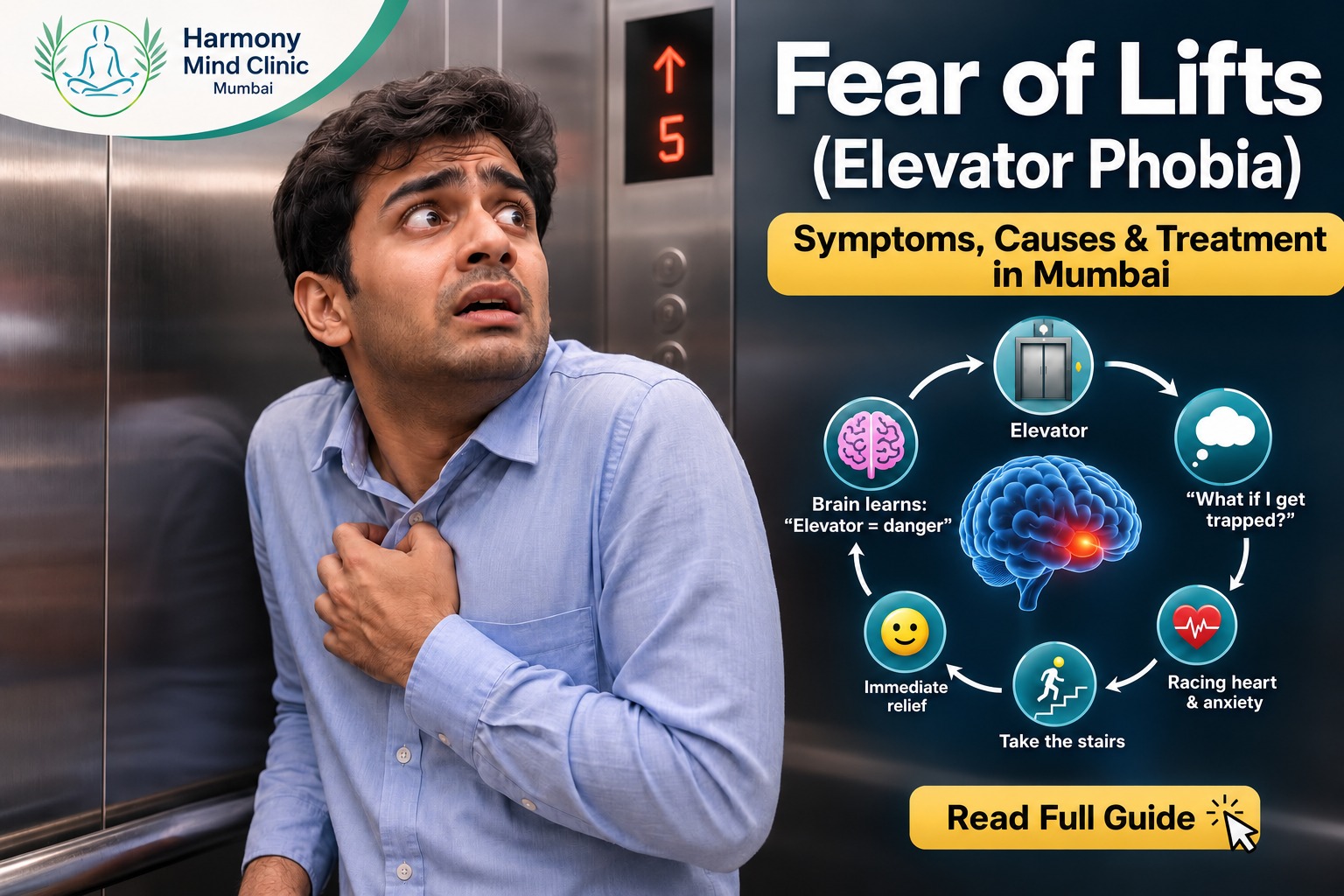
Fear of Lifts (Elevator Phobia): Symptoms, Causes & Treatment in Mumbai
Feeling slightly uncomfortable in a crowded or enclosed elevator is not unusual. But for some people, the fear becomes so intense that they avoid lifts altogether—even if that means climbing several floors, arriving exhausted, avoiding certain buildings or changing their daily routine.
This is commonly called elevator phobia or fear of lifts. Clinically, severe elevator fear may fall under specific phobia, situational type, although it can also overlap with claustrophobia, fear of heights, panic symptoms or fear of becoming trapped.
At Harmony Mind Clinic in Mumbai, we sometimes see patients who avoid the lift to the clinic itself and climb the stairs instead. With appropriate treatment, however, this fear can improve substantially and many people regain comfortable use of elevators.
How Common Is It?
There is no reliable prevalence estimate specifically for elevator phobia. However, specific phobias as a group are common: international population studies estimate a lifetime prevalence of about 7.4% and a 12-month prevalence of about 5.5%.
Why Does the Fear Keep Coming Back?
A typical cycle looks like this:
Elevator → “What if I get trapped?” → Racing heart and anxiety → Take the stairs → Immediate relief → Brain learns “stairs = safe, elevator = danger” → greater fear next time
This is one of the most important mechanisms maintaining a phobia.
Every time the person avoids the elevator, anxiety immediately falls. That relief unintentionally rewards the avoidance behaviour. As a result, the brain gets fewer opportunities to learn something new:
“I can enter an elevator, experience anxiety, tolerate it and remain safe.”
Over time, the person may become increasingly vigilant to elevator sounds, movements, closed doors, crowds or bodily sensations such as a racing heart.
What Happens in the Brain During Elevator Phobia?
Elevator phobia involves the brain’s threat-detection and learning systems becoming overly sensitive to the situation. When a person enters—or even anticipates entering—a lift, brain networks involved in detecting potential danger, including the amygdala and insula, can generate an alarm response even when there is no immediate threat. This activates the autonomic nervous system, producing a racing heart, sweating, breathlessness, dizziness and an urge to escape. The brain then learns from what happens next: if the person takes the stairs and immediately feels better, that relief reinforces avoidance. The brain therefore gets fewer opportunities to learn that “I can enter the elevator, tolerate the anxiety and remain safe.” Exposure therapy helps create this new learning, so that with repeated experience the elevator becomes less strongly associated with danger and the fear response becomes easier to regulate.
What Is Elevator Phobia?
Elevator phobia refers to an intense and disproportionate fear associated with entering, travelling in or sometimes even thinking about elevators.
Different people may fear different aspects of the experience:
- “What if the elevator gets stuck?”
- “What if the doors don’t open?”
- “What if I cannot breathe?”
- “What if I have a panic attack inside?”
- “What if I faint and nobody can help me?”
- “What if the elevator falls?”
- “What if I cannot escape?”
Some people primarily fear the enclosed space, while others fear loss of control, heights, mechanical failure, bodily sensations or being unable to escape.
The fear becomes clinically important when it causes significant distress, persistent avoidance or interference with work, travel, healthcare, relationships or everyday functioning.
Symptoms of Fear of Lifts
Symptoms may begin while approaching an elevator, waiting for one, entering it or even imagining having to use one.
Physical Symptoms
- Rapid heartbeat
- Sweating
- Shortness of breath or feeling of suffocation
- Trembling or shaking
- Dizziness or light-headedness
- Chest tightness
- Nausea
- Feeling hot or cold
- Strong urge to escape
Psychological and Behavioural Symptoms
- Intense anticipatory anxiety
- Repeated thoughts about getting trapped
- Fear of losing control
- Fear of fainting or having a panic attack
- Constantly watching the floor indicator or doors
- Standing close to the exit
- Entering only when accompanied by another person
- Avoiding crowded elevators
- Taking the stairs despite inconvenience or exhaustion
- Avoiding high-rise buildings altogether
Some people recognise that their fear is excessive but still find themselves unable to control the body’s alarm response.
What Causes Elevator Phobia?
There is rarely a single cause. Several mechanisms can contribute.
1. A Previous Frightening Experience
Being trapped in an elevator, experiencing a sudden stop, power failure, jerky movement or another frightening incident can create a strong association between elevators and danger.
The experience does not necessarily have to involve actual physical danger. A sufficiently intense panic response can itself become something the person subsequently fears.
2. Claustrophobic Fear
For some people, the main trigger is the enclosed environment.
The fear is often not simply:
“Small spaces are frightening.”
Instead, the underlying concern may be:
“What if I cannot get out when I need to?”
Elevators can be particularly potent triggers because they combine an enclosed space with closed doors, movement and temporary loss of control over when one can exit.
3. Fear of Panic Symptoms
Sometimes the person becomes frightened not primarily of the elevator but of what their own body might do inside it.
For example:
“What if my heart starts racing and I can’t escape?”
The person then develops a second layer of fear—fear of the anxiety response itself.
4. Fear of Losing Control or Being Trapped
Elevators temporarily place control of movement and exit in a machine rather than in the passenger’s hands. For someone particularly sensitive to uncertainty or loss of control, this can become a powerful trigger.
5. Learned Fear
Fear can also be learned indirectly—for example, after repeatedly hearing frightening stories about elevators or observing another person’s intense fear.
Why Avoiding Elevators Usually Makes the Problem Worse
Avoidance works extremely well in the short term.
You take the stairs and your anxiety decreases.
Unfortunately, that is precisely why avoidance becomes so powerful.
The brain can learn:
“I escaped, therefore there must have been something dangerous to escape from.”
The feared prediction is never adequately tested.
Over time, avoidance may expand. A person who initially avoids only crowded elevators may eventually avoid elevators altogether, followed by high-rise buildings, offices, hospitals, malls or other situations involving enclosed spaces.
Effective treatment therefore aims not merely to make someone “feel calm,” but to help the brain update its prediction of danger.
Treatment for Fear of Lifts in Mumbai
The encouraging part is that specific phobias are among the anxiety disorders for which we have effective psychological treatments.
Cognitive Behavioural Therapy (CBT)
CBT helps identify the thoughts, predictions and behaviours that maintain fear.
For example:
“If the elevator stops, I won’t be able to cope.”
Rather than simply reassuring the person that nothing bad will happen, therapy examines these predictions, develops more realistic interpretations and helps the person change behaviours that perpetuate fear.
Exposure Therapy
Exposure is a central evidence-based treatment for specific phobias.
Instead of repeatedly escaping the feared situation, the person gradually and systematically approaches it.
For elevator fear, a personalised exposure hierarchy might progress through:
Standing near an elevator → watching elevators operate → standing inside → travelling one floor with someone → travelling several floors → travelling alone → using unfamiliar or crowded elevators
The exact sequence is individualised.
The purpose is not to force someone into a terrifying situation. Instead, exposure provides the brain with opportunities for new learning.
The person gradually discovers:
“I can experience anxiety without escaping.”
“These sensations are uncomfortable, but I can tolerate them.”
“My feared prediction does not necessarily occur.”
“I do not need avoidance to keep myself safe.”
Research strongly supports exposure-based treatment for specific phobias. A 2022 meta-analysis involving 1,758 participants found large improvements with both single-session and multi-session exposure therapy.
Virtual Reality Exposure Therapy
Virtual Reality Exposure Therapy (VRET) can recreate feared situations in a controlled digital environment.
Research suggests that VR-based exposure can be useful for several specific phobias, particularly when real-world exposure is difficult to arrange.
For elevator fear, however, carefully planned real-life exposure is often practical and directly relevant. VR is therefore better considered another therapeutic tool rather than a requirement for successful treatment.
Internet- and Mobile-Based Treatment
Digital interventions for specific phobias are also being studied. Research suggests that internet- and mobile-based interventions containing exposure components can reduce phobic symptoms.
These approaches may improve access to treatment, although the evidence base remains smaller than that supporting established exposure-based psychotherapy.
Do Medicines Treat Elevator Phobia?
Medication is not usually the primary treatment for an isolated specific phobia.
If a person also has significant panic disorder, depression, generalized anxiety disorder or another psychiatric condition, medication may sometimes be appropriate for the associated condition after clinical assessment.
Repeatedly relying on a sedative every time an elevator must be used is not the same as treating the underlying phobia.
The central therapeutic objective is to help the person develop new learning so that avoidance and escape are no longer required.
When Should You Seek Professional Help?
Consider seeking professional assessment if fear of elevators:
- makes you routinely climb multiple floors despite significant inconvenience,
- causes panic attacks or severe anticipatory anxiety,
- interferes with work, healthcare, travel or social activities,
- causes you to avoid particular buildings or opportunities,
- is progressively becoming worse, or
- has persisted despite attempts to overcome it yourself.
A clinician should also determine whether the problem is best understood as a specific phobia or whether panic disorder, agoraphobia, claustrophobic fear, trauma-related symptoms or another anxiety disorder better explains the presentation.
Why Choose Harmony Mind Clinic, Mumbai?
At Harmony Mind Clinic, Mumbai, assessment focuses not only on the presence of fear but also on what the person predicts will happen, what they avoid, which safety behaviours they use and what keeps the fear alive.
Treatment can then be individualised using evidence-based approaches such as CBT and graded exposure therapy.
The objective is not merely to provide reassurance. It is to help the brain relearn that the situation can be approached without depending on avoidance or escape.
Conclusion
Fear of lifts may appear trivial to someone who has never experienced it. For the person affected, however, it can influence where they work, which buildings they enter, how they travel and even whether they attend medical appointments.
The important point is that avoidance does not have to become permanent.
With appropriate assessment and structured exposure-based treatment, elevator fear can often improve substantially, allowing people to use lifts again with much greater confidence and independence.
Dr Sagar Bhalke
MBBS, MD, DNB, Postdoctoral Fellow
Consultant Psychiatrist
Child and Adolescent Mental Health
Harmony Mind Clinic, Mumbai
References
- Wardenaar KJ, Lim CCW, Al-Hamzawi AO, et al. The cross-national epidemiology of specific phobia in the World Mental Health Surveys. Psychological Medicine. 2017;47(10):1744–1760. doi:10.1017/S0033291717000174.
- Mor S, Grimaldos J, Tur C, et al. Internet- and mobile-based interventions for the treatment of specific phobia: A systematic review and preliminary meta-analysis. Internet Interventions. 2021;26:100462. doi:10.1016/j.invent.2021.100462.
- Krzystanek M, Surma S, Stokrocka M, et al. Tips for Effective Implementation of Virtual Reality Exposure Therapy in Phobias—A Systematic Review. Frontiers in Psychiatry. 2021;12:737351. doi:10.3389/fpsyt.2021.737351.
- Odgers K, Kershaw KA, Li SH, Graham BM. The relative efficacy and efficiency of single- and multi-session exposure therapies for specific phobia: A meta-analysis. Behaviour Research and Therapy. 2022;159:104203. doi:10.1016/j.brat.2022.104203.
- Azimisefat P, de Jongh A, Rajabi S, et al. Efficacy of virtual reality exposure therapy and EMDR therapy on symptoms of acrophobia and anxiety sensitivity: A randomized controlled trial. Frontiers in Psychology. 2022;13:919148. doi:10.3389/fpsyg.2022.919148.
Reach out today.
📍 19th Floor, Panchratna Building, 1908 A, near Opera House, Charni Road, Opera House, Girgaon, Mumbai, Maharashtra 400004
📞 Call us at +919326652219
🌐 Visit harmonymindclinic.com


