
Presentation on Psychocutaneous Disorders in Women at GCBP 2026
The Brain–Skin Interface in Women: Reflections from Global Congress of Biological Psychiatry (GCBP) 2026, Jaipur
Why psychiatry, dermatology, immunology, endocrinology and neuroscience increasingly need to speak the same language
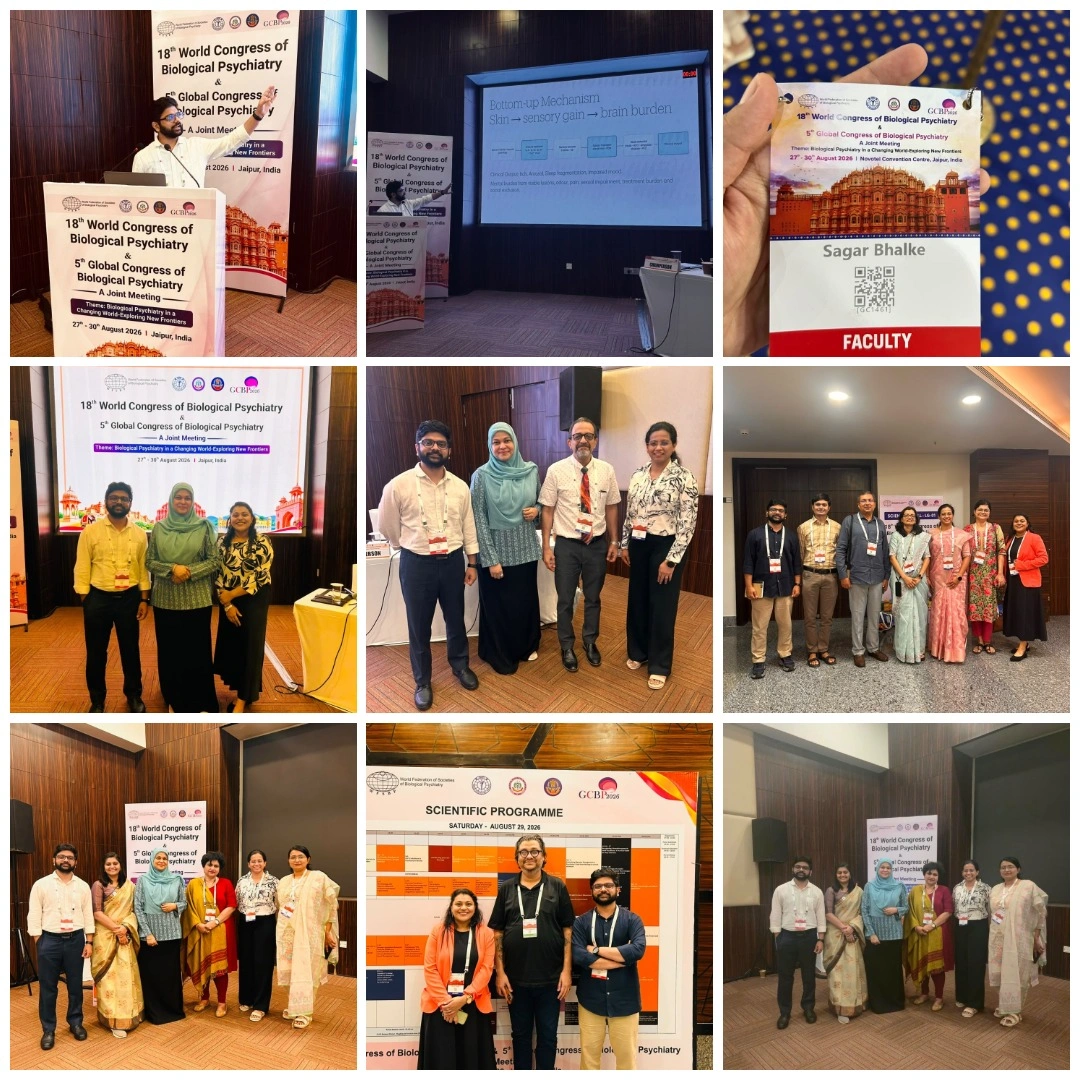
I recently had the opportunity to present “Psychocutaneous Disorders in Women” during the Women’s Mental Health Session at GCBP 2026 in Jaipur.
Rather than looking at psychiatric illness and dermatological disease as two independent categories, my presentation focused on a more biologically coherent idea: the brain and skin participate in a continuous, bidirectional network.
The clinical implications of this relationship are substantial.
The skin is not merely a surface organ
Skin is an extraordinarily active neuroimmune and endocrine organ. It contains sensory nerve endings, immune cells, vascular networks, local neuropeptide signalling systems and components capable of interacting with systemic stress biology.
At the same time, the central nervous system continuously receives information from the skin through sensory, nociceptive, pruriceptive and immunological pathways.
The result is not a simple sequence in which “stress causes a rash.” The biology is considerably more interesting.
Chronic dermatological disease may influence the brain through persistent inflammation, itching, pain, sleep disruption, altered body image, social exclusion and chronic stress exposure. These processes can contribute to depression, anxiety, cognitive burden and changes in quality of life.
The reverse direction is equally important.
Brain states can alter autonomic activity, hypothalamic–pituitary–adrenal signalling, behaviour, sleep and immune regulation. Psychiatric disorders may also influence scratching, picking, grooming, medication adherence and health behaviours. Some psychotropic medications themselves have dermatological consequences.
The clinically useful model is therefore:
- Brain
- endocrine system
- immune system
- autonomic nervous system , behaviour
- skin
— not a one-way psychosomatic explanation.
Why examine this specifically in women?
Women introduce additional layers of biological and clinical complexity.
Hormonal transitions across puberty, menstrual cycles, pregnancy, postpartum states and menopause interact with immune function, metabolism and central nervous system physiology. Many autoimmune diseases also show substantial sex differences in prevalence and phenotype.
Simultaneously, visible dermatological conditions can carry considerable psychosocial consequences related to body image, interpersonal relationships, sexuality, stigma and social functioning.
This means that the same skin disorder may have very different neuropsychiatric consequences depending on the person’s developmental stage, endocrine state, immune background, medications and social environment.
That is why good psychocutaneous medicine cannot be reduced either to dermatology alone or to the vague attribution that a condition is “because of stress.”
A broader session on women’s biological psychiatry
My presentation formed part of a larger session devoted to women’s mental health and biological psychiatry, led by Dr Ruksheda Syeda, a dear mentor, together with an excellent group of colleagues.
The programme examined female neurobiology from several intersecting perspectives—including brain biology, biomarkers, lifespan trajectories, gender-informed psychopharmacology, precision prescribing, liaison psychiatry, autoimmunity, cardiovascular psychiatry, oncology and psychocutaneous medicine.
I was particularly grateful to share this academic space with Dr Vaibhavi P S, a dear friend and mentor.
What I value about both Dr Ruksheda Syeda and Dr Vaibhavi is not simply their clinical expertise. Their approach combines scientific curiosity, intellectual openness, warmth and support for younger colleagues. It is a style of medicine that resonates strongly with the principles we are attempting to build at Harmony Mind Clinic: evidence should remain rigorous without making clinical care impersonal.
Four days of medicine beyond disciplinary boundaries
The presentation itself was only one part of the experience.
Dr Mauni and I had the opportunity to attend discussions by both young investigators and senior clinicians across subjects including human genetics, metabolomics, molecular pharmacology, neuroradiology, biological psychiatry and neuroscience.
These fields may appear separate on a conference schedule. Biologically, they increasingly converge.
Genomics can identify vulnerability.
Molecular biology can reveal mechanisms.
Metabolomics can characterize altered physiological states.
Neuroimaging can examine systems-level consequences.
Pharmacology can perturb those systems.
And careful clinical observation tells us whether any of this ultimately matters to the person sitting across from us.
That integration is increasingly where modern medicine is headed.
Moving beyond the “mind versus body” model
Perhaps the most important message from my psychocutaneous presentation was also the simplest:
The traditional separation between mental illness and physical illness is becoming scientifically difficult to defend.
This does not mean every dermatological disorder is psychiatric, nor that psychological stress explains every exacerbation of skin disease.
Quite the opposite.
A rigorous brain–body model requires us to investigate immune signalling, neuroendocrine biology, autonomic regulation, genetics, environmental exposure, medication effects, behaviour and subjective experience simultaneously, while being careful about what is causal and what is merely associated.
Psychocutaneous medicine is one particularly visible example of this broader principle.
A patient presenting with psoriasis, alopecia, atopic dermatitis, acne, chronic pruritus, trichotillomania or skin-picking behaviours may require us to think beyond a single organ system.
That is not “holistic medicine” as a slogan.
It is increasingly systems biology applied to clinical medicine.
What I brought back to Harmony Mind Clinic
Conferences are useful when they change how one thinks on Monday morning.
For us, GCBP 2026 reinforced an approach we have increasingly adopted at Harmony Mind Clinic: psychiatric symptoms should be understood within the biology of the whole person.
That means asking not only:
What diagnosis does this person have?
but also:
What interacting neural, immune, endocrine, metabolic, developmental, pharmacological and environmental processes might be producing the phenotype we see?
That is a harder question.
It is also a considerably more interesting—and potentially more useful—one.
And after four days of science, conversations, old friends, new colleagues and mentors in Jaipur, that was perhaps the strongest takeaway:
The future of psychiatry will not be built inside psychiatry alone.
It will emerge at the intersections between neuroscience, genetics, immunology, endocrinology, medicine, pharmacology and human behaviour.
That is exactly where we intend to keep looking.
— Dr Sagar Bhalke
Consultant Psychiatrist
Harmony Mind Clinic
The Brain–Skin Interface in Women: Reflections from GCBP 2026
Reach out today.
📍 19th Floor, Panchratna Building, 1908 A, near Opera House, Charni Road, Opera House, Girgaon, Mumbai, Maharashtra 400004
📞 Call us at +919326652219
🌐 Visit harmonymindclinic.com


Visiting Hours
Harmony Mind Clinic
-
Mon - Sun :
24/7 hrs
Online consultation
Whole Week :
24/7 hrs

© 2026 Copyright : Harmony Mind Clinic | Managed by Owl Prime