
Illness Anxiety Disorder: Why You Keep Thinking You Have a Serious Disease
Why Do I Keep Changing Doctors Even When My Tests Are Normal? Understanding Illness Anxiety Disorder
Have you ever been concerned that a minor headache, stomach pain, or a cough may be a sign of a serious illness? Although occasional worry about your health is not unusual, a constant belief that you’re suffering from a serious condition regardless of your regular medical examinations could be a sign of illness Anxiety Disorder (IAD).
Illness Anxiety Disorder does not mean that physical symptoms are imaginary, nor should new or medically concerning symptoms automatically be attributed to anxiety. Diagnosis requires appropriate medical assessment. The problem in IAD is the persistent and disproportionate fear of serious illness despite appropriate evaluation and reassurance.
Previously known as hypochondriasis, illness anxiety disorder refers to a psychological health issue which causes people to have a lot of anxiety about developing or having a serious medical condition. This anxiety can affect everyday life, relationships and general well-being. At the Harmony Mind Clinic, experienced mental health professionals assist patients in learning to manage anxiety and illness with evidence-based therapies.
What Is Illness Anxiety Disorder?
Illness Anxiety Disorder is defined by a constant anxiety over health, even though there aren’t any significant physical symptoms or tests showing signs of serious health issues. Patients suffering from this disorder often interpret normal body symptoms like muscle pains and fatigue as indicators of a potentially dangerous illness.
Health anxiety is high, the person is easily alarmed by bodily sensations, and the pattern generally persists for at least six months. Some people repeatedly seek consultations and investigations (care-seeking type), while others avoid doctors or hospitals because they fear receiving bad news (care-avoidant type).
The anxiety persists even after receiving assurance from doctors, which can lead to frequent medical appointments or, in some instances, completely avoiding medical treatment due to the fear of hearing negative information.
For example:
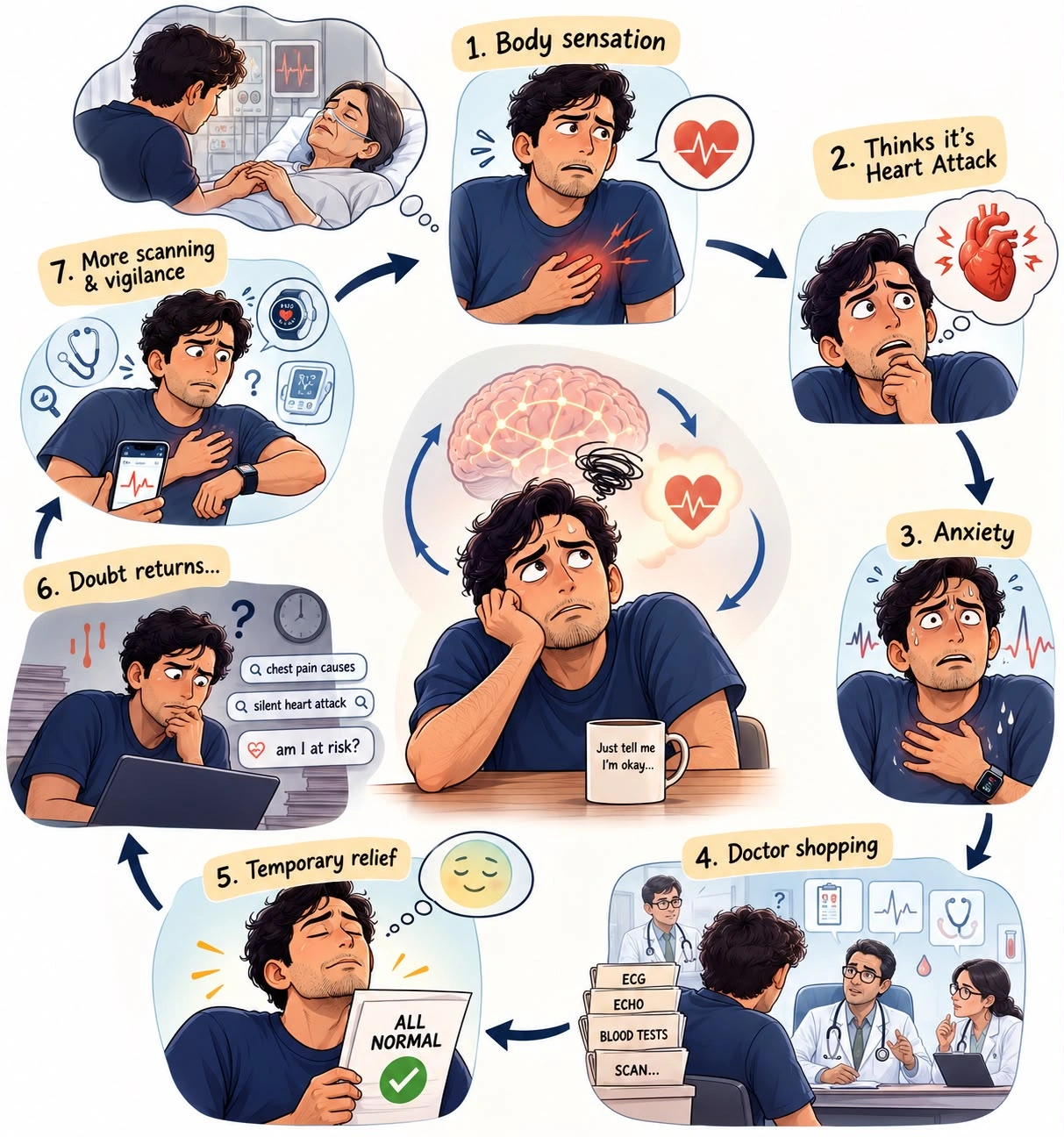
“My heart skipped a beat.” becomes “Something is wrong with my heart.” which becomes “I must check my pulse.” then “I should Google this.” then “I need an ECG just to be safe.” The ECG provides short-term relief. But psychologically, the patient learns: “I survived because I checked.”
Neurobiology
Current models suggest that severe health anxiety may involve altered processing of bodily signals, attention, threat appraisal and uncertainty.
Networks involved in interoception (monitoring internal body signals), particularly the insula and anterior cingulate cortex, interact with threat- and emotion-processing systems such as the amygdala and regulatory prefrontal networks.
A harmless sensation—such as a palpitation, mild headache or stomach movement—may therefore be interpreted as evidence of serious disease. This interpretation increases autonomic arousal, producing real physical sensations such as faster heartbeat, sweating, muscle tension or dizziness, which are then noticed and interpreted as further evidence of illness.
Repeated body checking, internet searching, medical testing and reassurance may temporarily reduce anxiety but can reinforce the cycle by teaching the brain that checking was necessary for safety.
Thus, illness anxiety is better viewed not as “imagining symptoms,” but as altered attention, threat interpretation, learning and uncertainty processing around genuine bodily information; importantly, there is currently no single brain region, neurotransmitter abnormality or biomarker proven to specifically explain Illness Anxiety Disorder.
Common Symptoms of Illness Anxiety Disorder
Patients with anxiety and illness disorders may be affected by:
A constant fear of developing an illness of serious nature
Regular self-checking for symptoms of illness
Internet searches that are excessively related to medical illnesses
Repeated doctor visits despite normal test results
Not convinced by medical advice
Why Does Health Anxiety Develop?
- personal or family experiences of serious illness
- previous frightening medical experiences
- heightened attention to bodily sensations
- intolerance of uncertainty
- catastrophic interpretation of ambiguous sensations
- anxiety vulnerability
- repeated reassurance/checking behaviours that become learned
- excessive online health searching
- major stressors or exposure to illness-related information
There is usually no single cause, and these factors do not mean that someone will develop IAD.
Effective Treatment Options
The positive side is that the illness anxiety disorder can be treated.
Treatments could comprise the following:
Cognitive Behavioural Therapy (CBT) can help recognize and modify unhealthy thought patterns that are related to health.
Medication is not required for everyone. In some patients—particularly when significant anxiety, depression, OCD-spectrum symptoms or other psychiatric conditions coexist—a psychiatrist may consider medications such as SSRIs. Medication should be individualized rather than used simply to suppress every episode of health-related anxiety.
Psychoeducation: Understanding anxiety can help patients understand and manage their anxiety.
Treatment for illness anxiety does not mean teaching someone to ignore genuine symptoms. The aim is to distinguish proportionate medical vigilance from anxiety-driven checking and to develop a planned approach to healthcare rather than repeatedly seeking investigations for temporary reassurance.
If this sounds familiar
Choose one trusted primary doctor/physician to coordinate medical care rather than repeatedly changing doctors. Follow an agreed plan for when symptoms require investigation. Avoid repeatedly checking pulse, BP, oxygen saturation or other measurements unless medically advised. Reduce repetitive symptom searching online. Notice how long reassurance actually relieves anxiety. If the cycle continues to consume time, money or emotional energy, consider assessment for health anxiety/IAD.
Conclusion
In the Harmony Mind Clinic, experienced psychologists and psychiatrists offer individualized treatment for patients suffering from illnesses such as anxiety disorder or other stress-related disorders. With a thorough assessment and scientifically tested treatments, the clinic assists patients in managing their health issues and restoring their peace of mind.
If the constant worry about illness is taking over your life, seeking out professional treatment can aid you in breaking the pattern of anxiety and focusing on a more healthy, more enjoyable life.
Dr Mauni Nagda
MBBS, MD, DNB, Postdoctoral Fellowship
Consultant Psychiatrist
Deaddiction
References–
- Kikas K, Werner-Seidler A, Upton E, Newby JM. 2024. Illness Anxiety Disorder: A Review of the Current Research and Future Directions. Current Psychiatry Reports. 26:331–339. DOI: 10.1007/s11920-024-01507-2.
- Mataix-Cols D, Isomura K, Sidorchuk A, et al. 2024. All-Cause and Cause-Specific Mortality Among Individuals With Hypochondriasis. JAMA Psychiatry. 81(3):284–291. DOI: 10.1001/jamapsychiatry.2023.4744.
- Axelsson E et al. 2020. Effect of Internet vs Face-to-Face Cognitive Behavior Therapy for Health Anxiety: A Randomized Noninferiority Clinical Trial.
Reach out today.
📍 1908 A,19th Floor, Panchratna Building, Charni Road, Girgaon, Mumbai, Maharashtra 400004
📞 Call us at +919326652219
🌐 Visit harmonymindclinic.com


