
Childhood OCD A Parent’s Guide to Symptoms, Diagnosis & Treatment
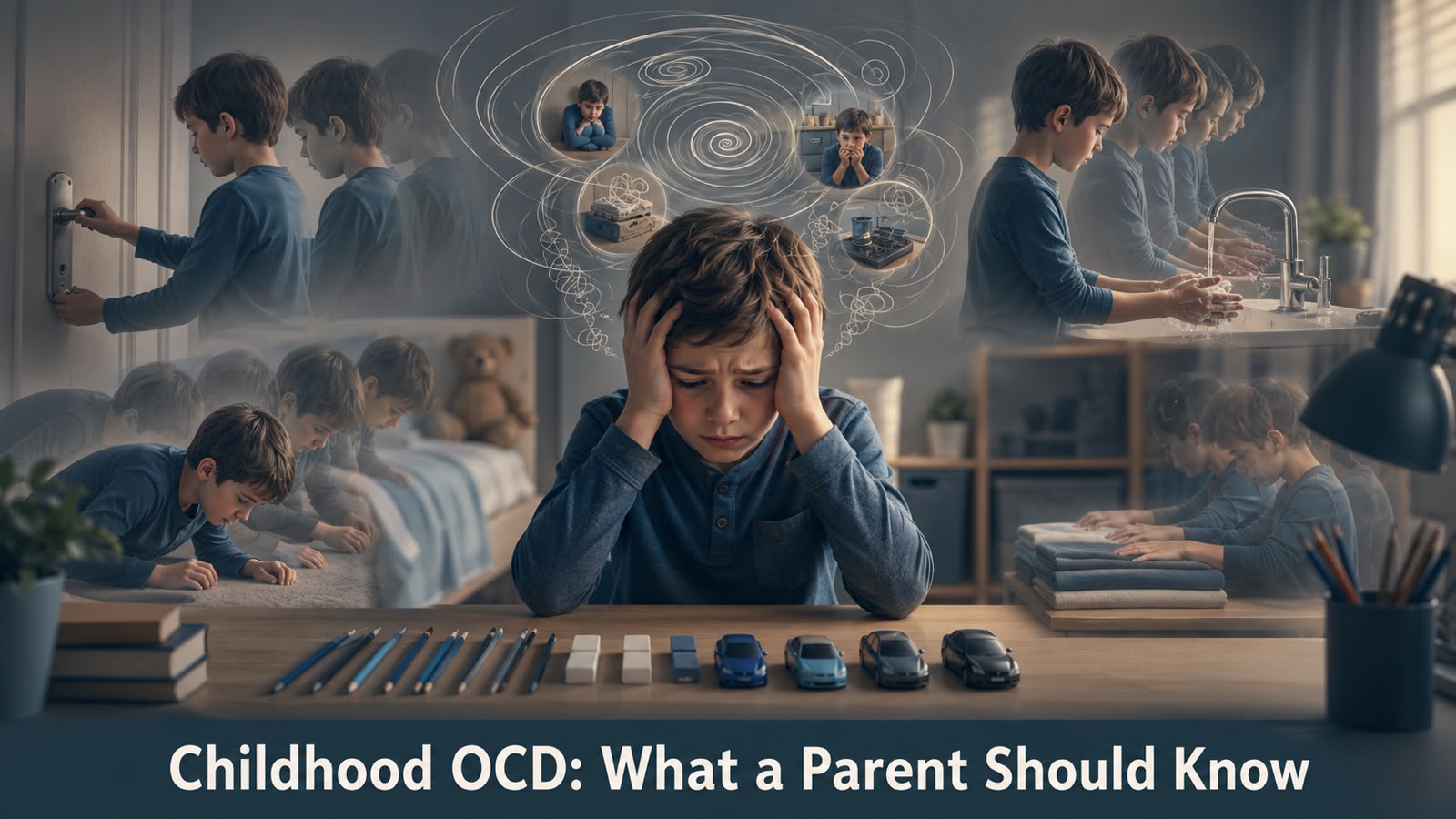
Childhood obsessive-compulsive disorder (OCD) is a common but often misunderstood mental health condition. Children with OCD experience unwanted, distressing thoughts (obsessions) and feel driven to perform repetitive behaviours or mental rituals (compulsions) to reduce anxiety. Without treatment, OCD can interfere with school performance, friendships, family relationships and emotional development. Fortunately, early diagnosis and evidence-based treatment can lead to significant improvement.
What is Childhood OCD?
Childhood OCD is a neuropsychiatric disorder characterised by intrusive, unwanted thoughts, images or urges (obsessions) and repetitive behaviours or mental rituals (compulsions). Unlike normal childhood habits or routines, OCD symptoms consume time, cause distress and interfere with daily functioning.
Children usually recognise that something feels “wrong”, but younger children may struggle to explain why they perform these rituals.
Childhood OCD by the Numbers
Around 1–3% of children and adolescents experience OCD.
Nearly 50% of adults with OCD report that their symptoms began during childhood or adolescence.
On average, children often experience symptoms for 2–3 years before receiving the correct diagnosis, delaying treatment
Common Signs and Symptoms of Childhood OCD
The symptoms of OCD are usually two types: obsessions and compulsions.
Obsessions
Obsessions are thoughts, fears or pictures that keep coming into a child’s mind.
Examples of obsessions in children include:
- Fear of making mistakes
- Fear of contamination
- Fear that something terrible may happen
- Fear of harming loved ones
- Need for symmetry or exactness
- Religious or moral fears
- Intrusive sexual thoughts (in older adolescents)
Compulsions
Compulsions are repetitive behaviours that people with anxiety disorders perform in an attempt to feel better or to lessen their worry about something. Compulsions allow a person to cope with the feelings caused by obsessions. Some common compulsions include:
- Excessive hand washing
- Repeated reassurance seeking
- Rechecking homework
- Repeating words silently
- Mental counting
- Arranging objects
- Re-reading
- Confessing repeatedly
- Avoiding certain numbers
- Excessive praying
Clinical Example 1
An 8-year-old repeatedly washes his hands for nearly an hour every evening because he believes invisible germs will make his parents sick.
Clinical Example 2
A 12-year-old spends 90 minutes rewriting homework because every letter has to “look perfect.”
Clinical Example 3
A 10-year-old repeatedly asks his mother, “Are you sure you’re safe?” dozens of times every day, despite already knowing the answer.
Causes of Childhood OCD
The cause of OCD is still unknown. Things that may contribute include:
Genetic Factors
A child whose family includes members who have OCD, anxiety disorders or related mental health conditions may be at an increased risk of developing OCD.
Brain Function Differences
Research shows that some brain circuits that help with decision-making, behaviour control and anxiety might not work properly.
Environmental Triggers
Stressful events, trauma, illness or big changes in a child’s life can, sometimes. Make OCD symptoms worse.
What Happens in the Brain in Childhood OCD?
Research suggests that OCD develops because certain brain circuits become overactive.
The main network involved is known as the cortico-striato-thalamo-cortical (CSTC) circuit, which connects the:
- Orbitofrontal cortex (detects potential errors or threats)
- Anterior cingulate cortex (signals that something feels “not right”)
- Basal ganglia (helps filter thoughts and actions)
- Thalamus (relays information back to the cortex)
In children with OCD, this circuit may become excessively active, causing the brain to repeatedly send “warning signals” even when there is no real danger. As a result, the child feels compelled to perform rituals in an attempt to reduce anxiety.
Neurotransmitters such as serotonin, glutamate, and dopamine are also thought to contribute, which is why medications that increase serotonin can help reduce symptoms.
Treatment Options for Childhood OCD
The news is that OCD in children can be treated effectively.
Cognitive Behavioral Therapy (CBT)
CBT and Exposure and Response Prevention (ERP) work well. It helps kids face their fears and learn to resist OCD behaviours.
Medication
In cases doctors might prescribe medications like Selective Serotonin Reuptake Inhibitors (SSRIs) to reduce OCD symptoms.
When Should Parents Seek Help?
Parents should consider a professional evaluation if their child’s rituals:
- Take more than one hour daily
- Cause significant distress
- Delay schoolwork or bedtime
- Lead to family conflict
- Prevent participation in normal activities
- Continue despite reassurance
Conditions That Can Look Like OCD
Parents frequently confuse OCD with other conditions.
|
OCD |
ADHD |
Autism |
Anxiety |
|
Rituals reduce anxiety |
Distractibility |
Preference for routines |
Worry without rituals |
Common Myths
Examples:
❌ OCD is just being neat.
✔ OCD is driven by anxiety, not cleanliness.
❌ Children will simply outgrow OCD.
✔ Untreated OCD often persists and may worsen over time.
❌ Talking about intrusive thoughts makes them worse.
✔ Discussing intrusive thoughts openly can actually help children receive the right treatment.
Prognosis
Most children improve substantially with early treatment. Many experience significant symptom reduction through cognitive behavioural therapy with exposure and response prevention (ERP), family support, and, when necessary, medication. Early intervention is associated with better long-term academic, social and emotional outcomes.
Conclusion
Childhood OCD is a health condition that can be managed effectively when diagnosed early and treated appropriately. When families understand the symptoms and available treatment options, they can seek professional help at the right time. Expert mental health support from clinics in Mumbai such as Harmony Mind Clinic can play an important role in helping children overcome the challenges of obsessive-compulsive disorder. With proper treatment, guidance, and strong family support, children with OCD can improve their symptoms, build confidence, and thrive in their daily lives.
References
- National Institute for Health and Care Excellence (NICE). Obsessive-compulsive disorder and body dysmorphic disorder. NG31.
- American Academy of Child and Adolescent Psychiatry (AACAP). Practice Parameters for OCD.
- International OCD Foundation (IOCDF)
- American Psychiatric Association. DSM-5-TR.
- National Institute of Mental Health (NIMH)
Reach out today.
📍 19th Floor, Panchratna Building, 1908 A, near Opera House, Charni Road, Opera House, Girgaon, Mumbai, Maharashtra 400004
📞 Call us at +919326652219
🌐 Visit harmonymindclinic.com


Visiting Hours
Harmony Mind Clinic
-
Mon - Sun :
24/7 hrs
Online consultation
Whole Week :
24/7 hrs

© 2026 Copyright : Harmony Mind Clinic | Managed by Owl Prime