
Which Exercise Is Best for Mental Health? A Brain-Based Guide to Movement Therapy
The present-day world experiences a rapid pace of life, which results in more people developing mental health problems, including stress and anxiety and depression. The combination of therapy and medicines has value, yet exercise has developed into a strong natural method (preventive and curative) which enhances one’s brain health. The Harmony Mind Clinic and similar facilities provide experts who recommend movement therapy as a complete treatment method for mental health. The question about which exercise benefits mental health most needs to be answered. The answer depends on knowing how various movement patterns affect brain function.
The Brain Benefits of Physical Activity
Exercise goes beyond improving physical strength because it brings about changes to both brain physiological and chemical makeup and brain operational capabilities. (1) Physical activity leads to these three outcomes:
Exercise serves as a pathway to enhance physical health while it brings about changes to brain functions through its effects on brain chemistry. The process of physical activity results in the following effects on the body:
Endorphins (feel-good hormones) are released, which brings two effects that include pain relief and improved mood.
The body experiences an increase in serotonin and dopamine, which assists with emotional control.
The body experiences a reduction in cortisol, which serves as the stress hormone.
Brain-derived neurotrophic factor (BDNF) functions to support the development of brain cells and the process of memory formation.
Best Types of Exercise for Mental Health
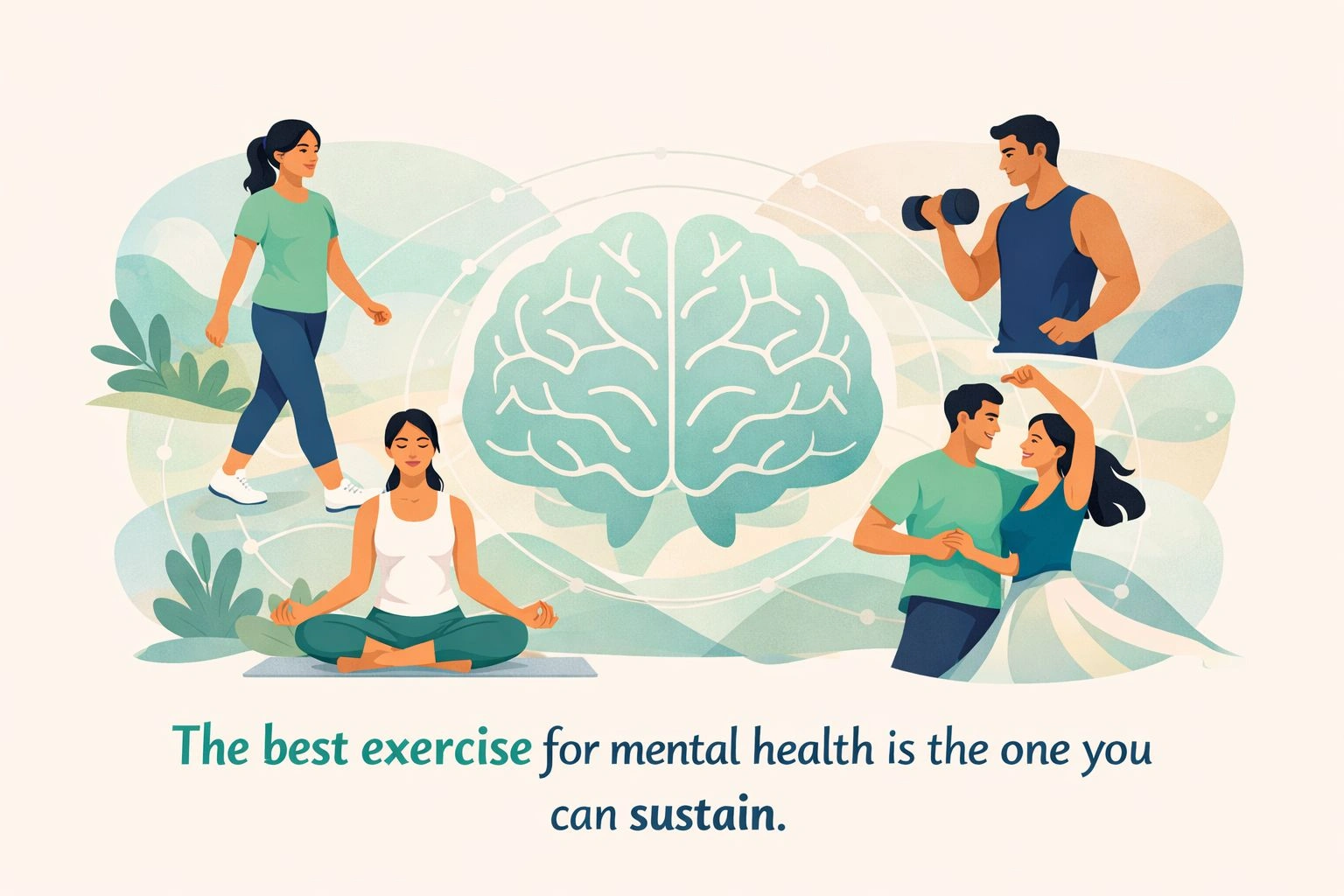
People need to find their best exercises because different exercises help different people achieve mental health improvement.
1. Aerobic Exercise (Cardio)
People who run or walk quickly or ride bicycles or swim can achieve better mental health through these activities. (2)
Benefits:
The treatment produces immediate mood enhancement.
The treatment results in better sleep patterns.
The treatment leads to a decrease in stress levels.
2. Yoga and Mindful Movement
Yoga uses physical postures together with breathing exercises and meditation to create an effective mental health practice. (3)
Benefits:
The practice helps people achieve deep relaxation and inner peace The technique helps people with anxiety and depression symptoms
The technique enhances both concentration abilities and emotional stability
3. Strength Training
Weight lifting and resistance exercises serve dual purposes because they help people build muscles while developing their mental toughness.
Benefits:
The program helps people increase their self-worth and self-assurance.
The program helps people decrease their depressive symptoms. The program helps people enhance their mental abilities.
4. Dance and Recreational Activities
Fun activities like dancing sports or group fitness classes enable people to exercise while they interact with others.
Benefits:
The program improves mood through enjoyable activities.
The program helps people overcome their loneliness.
The program motivates people to maintain their exercise routine.
Conclusion
There is no single “best” exercise for mental health—rather, it’s about finding the right balance of activities that support your mind and body. Movement therapy uses various forms of exercise, which include calming yoga sessions and energizing runs and peaceful nature walks, to improve your mental health. Regular exercise combined with professional help from Harmony Mind Clinic experts will lead you to significant progress toward better mental health and increased happiness.
Scientific references:
1. Singh B, Olds T, Curtis R, Dumuid D, Virgara R, Watson A, Szeto K, O’Connor E, Ferguson T, Eglitis E, Miatke A, Simpson CE, Maher C. Effectiveness of physical activity interventions for improving depression, anxiety and distress: an overview of systematic reviews. Br J Sports Med. 2023 Sep;57(18):1203-1209. doi:
10.1136/bjsports-2022-106195. Epub 2023 Feb 16. PMID: 36796860; PMCID: PMC10579187.
2. Noetel M, Sanders T, Gallardo-Gómez D, Taylor P, Del Pozo Cruz B, van den
Hoek D, Smith JJ, Mahoney J, Spathis J, Moresi M, Pagano R, Pagano L, Vasconcellos R, Arnott H, Varley B, Parker P, Biddle S, Lonsdale C. Effect of exercise for depression: systematic review and network meta-analysis of randomised controlled trials. BMJ. 2024 Feb 14;384:e075847. doi:
10.1136/bmj-2023-075847. Erratum in: BMJ. 2024 May 28;385:q1024. doi:
10.1136/bmj.q1024. PMID: 38355154; PMCID: PMC10870815.
3. Brinsley J, Schuch F, Lederman O, Girard D, Smout M, Immink MA, Stubbs B, Firth J, Davison K, Rosenbaum S. Effects of yoga on depressive symptoms in people with mental disorders: a systematic review and meta-analysis. Br J Sports Med. 2021 Sep;55(17):992-1000. doi: 10.1136/bjsports-2019-101242. Epub 2020 May 18. PMID: 32423912.
Reach out today.
📍 19th Floor, Panchratna Building, 1908 A, near Opera House, Charni Road, Opera House, Girgaon, Mumbai, Maharashtra 400004
📞 Call us at +919326652219
🌐 Visit harmonymindclinic.com


Visiting Hours
Harmony Mind Clinic
-
Mon - Sun :
24/7 hrs
Online consultation
Whole Week :
24/7 hrs

© 2026 Copyright : Harmony Mind Clinic | Managed by Owl Prime